sing Dictionaries
Technology is changing the face of dictionaries. A short twenty or thirty years ago, a good graduation gift for a college-bound student was a hardcover dictionary. Today very few college students even own one because online dictionaries are so readily available. Using an online dictionary, you can look up a word in the time it takes to type it, as opposed to taking the time to flip pages and scan through a page of words in a print dictionary. On the other hand, a hard-copy dictionary is still a great backup if you’re unable to get online, and it can lead to some surprising discoveries of other words on the same page, just as browsing through a shelf of library books can put you in contact with books you might not have otherwise encountered.
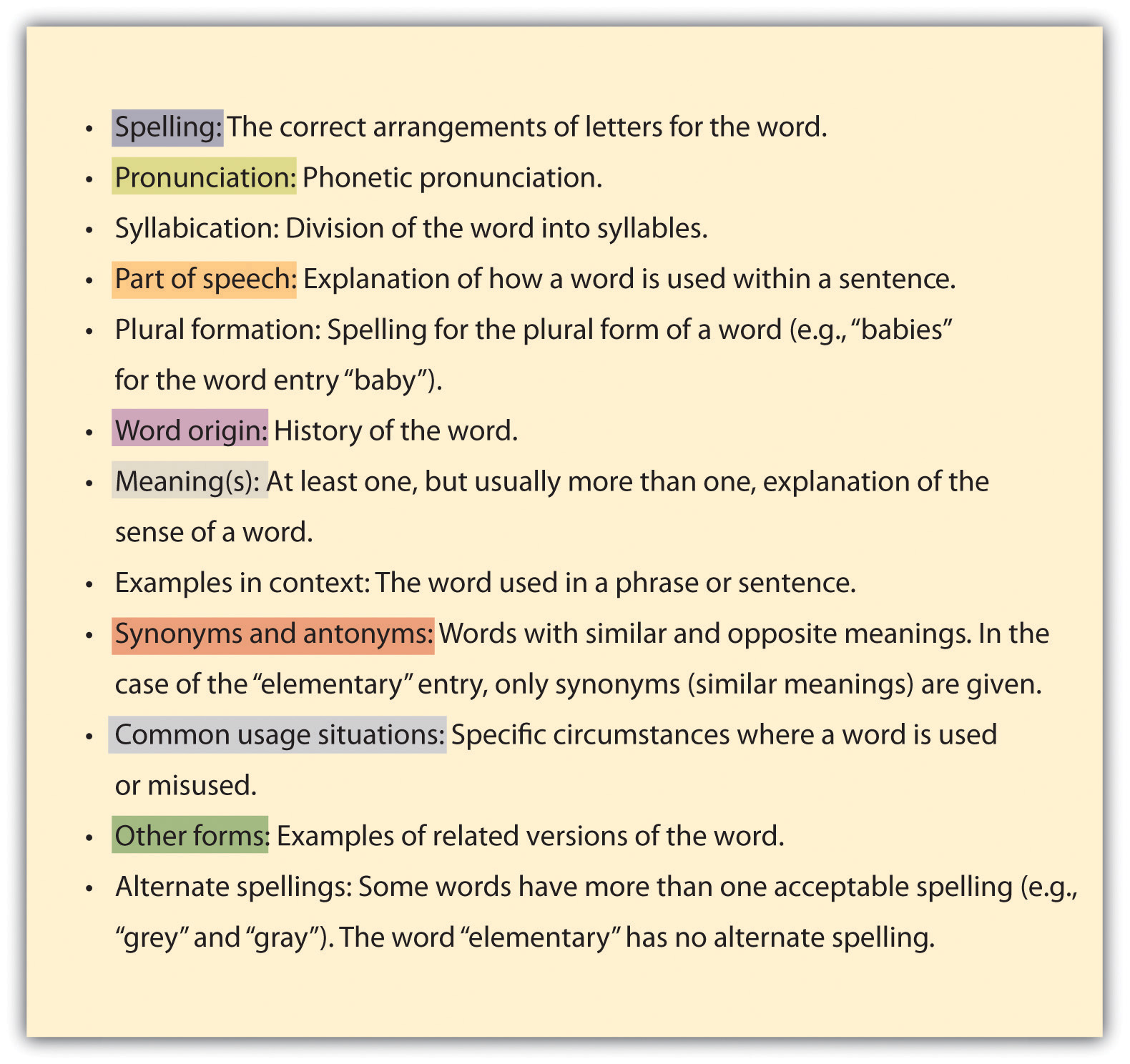
The important issue is that you use a dictionary of some kind and that you understand what it can provide for you. Whether you use a print or online dictionary, the entries offer a wealth of information. Figure 17.2 includes some of the most common dictionary entry components. Following the list is a color-coded entry for “elementary” (from Dictionary.com, based on the Random House Unabridged Dictionary) showing where various parts of the entry can be found:
Figure 17.2